
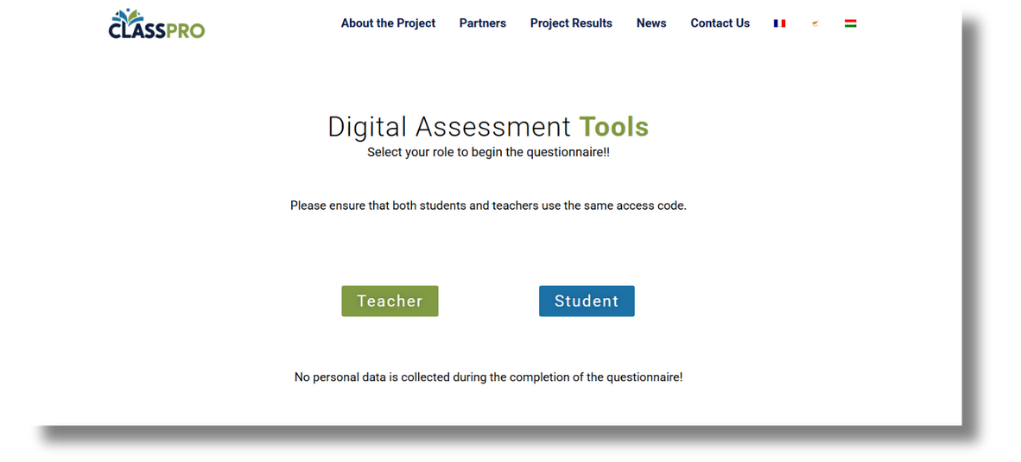
The ClassPRO Digital Assessment Tool (DAT) helps secondary school teachers understand how their classrooms feel from both their own and their students’ perspectives, and to use that insight for practical improvement. Instead of producing grades or rankings, it focuses on experiences: how safe, supported and engaged people feel, and how different subjects are perceived.
The tool is built around a short online questionnaire completed separately by teachers and students, with a particular focus on STEM and language lessons where anxiety, perceived difficulty and questions about relevance are common. Both groups answer parallel questions in three areas: emotional classroom climate (motivation, safety, support), teacher–student value alignment (expectations, collaboration, respect) and subject‑specific experiences (confidence, usefulness, attitudes towards a subject and its broader “family”).
Teachers generate a code, complete their survey and share the link and code with their class. Students enter the code, respond anonymously and submit their answers. The system uses the code to match the teacher’s responses with the aggregated student data without collecting names. It then produces clear visual summaries showing where perceptions align and where they diverge. A teacher might discover, for instance, that while they see lessons as calm and well‑structured, students report frequent disruptions or low confidence in a specific subject.
Crucially, DAT is designed as a reflective aid, not an evaluation tool. It aims to support teachers in questioning assumptions and making evidence‑informed adjustments, rather than adding another layer of judgement. A structured reflection guide encourages teachers to identify a small number of key gaps, consider what students might be experiencing, acknowledge existing strengths, select one realistic change to try over the next weeks, and plan how to revisit its impact.
The tool also offers a practical framework for student voice. An accompanying classroom activity, “Understanding Our Classroom Experience”, invites teachers to share general patterns from the results and then guide small‑group discussions on areas such as values, climate, relationships or understanding of the topic. Each group proposes one action for the teacher and one for students. The class agrees on a few concrete next steps and a time to review them, turning feedback into a shared problem‑solving process.
Subject‑specific items recognise that not all disciplines are experienced in the same way. STEM subjects often feel rigid and high‑stakes, while language and literature classes can be rich in discussion yet intimidating or seemingly irrelevant. By comparing teacher and student views on each subject’s difficulty, relevance and future usefulness, the tool reveals patterns that support more targeted classroom management and support.
Because it gathers sensitive perceptions from young people, DAT is designed with strong safeguards: responses are anonymous, matched only via codes, and handled under a clear data management plan that aligns with privacy regulations. The interface is accessible and mobile‑responsive so teachers and students can participate easily.
Pilots in partner schools in Cyprus, Hungary and France are currently refining the questionnaires, dashboards and guidance. Their insights will feed into a practical handbook offering ready‑to‑use prompts, example classroom conversations and subject‑specific strategies. Overall, the Digital Assessment Tool invites teachers and students to move beyond the question “How did we perform?” and instead ask “How does this classroom feel – and how can we improve it together?”